

Advance Tax Due Date 2026: Who Must Pay by 15 December
Advance tax due date 15 December 2026: who must pay, the four instalments, a worked ₹ example, interest if you miss a date and how to pay online.

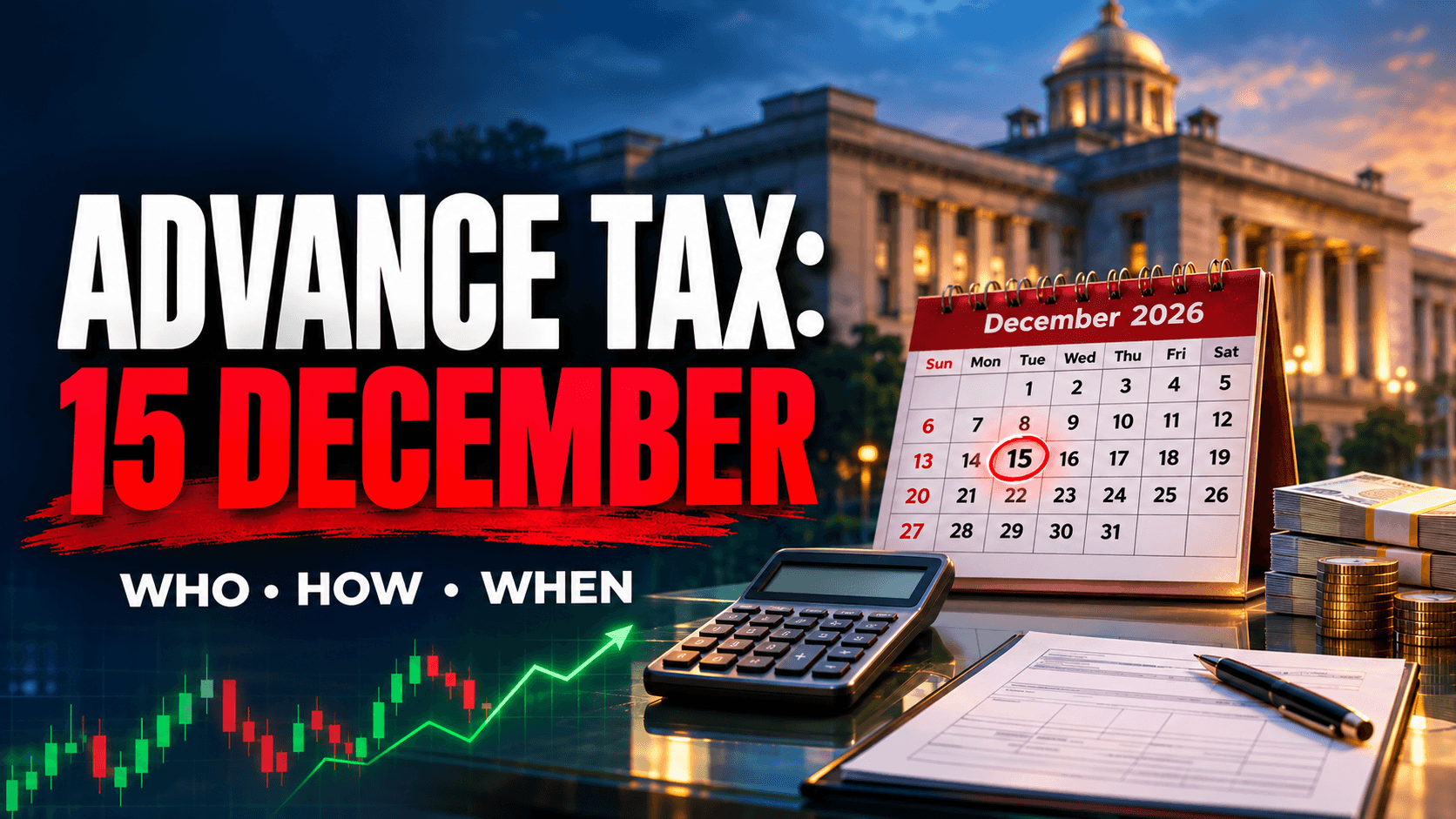
What is the advance tax due date this year? The next one is 15 December 2026, by which you should have paid at least 75% of your tax for the year. Advance tax is income tax you pay in instalments during the year, instead of one lump sum at the end.
Most salaried people never think about it, because the employer deducts tax every month. But if you also earn interest, rent, freelance income or gains from shares and mutual funds, your employer's deduction may not cover everything. This guide shows who must pay, the four dates, how to work out the amount and what happens if you miss a date.
What is advance tax?
Advance tax means paying your income tax as you earn, in four parts, rather than waiting for March. It is also called "pay as you earn" tax. You pay it yourself, on the income tax website or through a bank, using your own estimate of the year's income.
From 1 April 2026 India runs on the Income-tax Act, 2025, which calls the year a "tax year" (2026-27) instead of a "financial year". The advance tax dates and percentages stayed the same as before. Section numbers changed, so a page that quotes the old section 208 or 234C is describing the same idea under the older law.
Advance tax due date 2026-27: the four instalments
The percentages are cumulative. That means each date shows the total you should have paid by then, not a fresh amount.
| Instalment | Due date | Pay at least (total so far) |
|---|---|---|
| First | 15 June 2026 | 15% |
| Second | 15 September 2026 | 45% |
| Third | 15 December 2026 | 75% |
| Fourth | 15 March 2027 | 100% |
If you have already paid the first two instalments, you only need to top up to 75% by 15 December. If you have paid nothing so far, you can still pay 75% in one go on or before that date, though interest will have started running for the earlier dates (see below).
Who must pay advance tax?
You must pay advance tax if the tax you owe for the year, after subtracting the tax already deducted at source (TDS) or collected at source (TCS), is ₹10,000 or more. This applies to salaried people with other income, freelancers, professionals, business owners, landlords and investors.
Who does not need to pay
- Resident senior citizens aged 60 or above who have no income from business or profession.
- Salaried people whose whole tax is already covered by TDS.
- Taxpayers who opted for presumptive taxation under section 44AD or 44ADA, who can pay the whole amount in one go by 15 March.
Check the rule on the income tax e-filing portal before you rely on a summary, since conditions can change with a notification.
How to calculate advance tax: a worked example
Priya is a salaried employee. At the start of the year she estimates her total tax at ₹80,000. Her employer will deduct ₹30,000 as TDS. The tax she must pay herself is ₹80,000 minus ₹30,000, which is ₹50,000.
| Date | Total to have paid | Pay on that date |
|---|---|---|
| 15 June 2026 | ₹7,500 (15%) | ₹7,500 |
| 15 September 2026 | ₹22,500 (45%) | ₹15,000 |
| 15 December 2026 | ₹37,500 (75%) | ₹15,000 |
| 15 March 2027 | ₹50,000 (100%) | ₹12,500 |
Her income can change during the year, so she re-checks the estimate before each date. If she earns more interest than planned, the next instalment goes up. You can estimate the interest part of your own income with the FD calculator or the RD calculator, then add it to your tax estimate.
What happens if you miss the advance tax due date?
The tax department charges simple interest on the shortfall, at 1% for each month or part of a month. Two kinds of interest apply:
- For missing an instalment: 1% a month for 3 months on the shortfall of the June, September and December instalments, and for 1 month on the March shortfall.
- For paying too little over the whole year: if you have paid less than 90% of your tax by 31 March, 1% a month is charged on the shortfall from 1 April until you pay.
Example: Priya pays ₹5,000 less than she should have on 15 December. The interest for that missed amount is ₹5,000 × 1% × 3 months = ₹150. Small numbers, but it grows if the shortfall is larger.
There is some relief: if you have paid at least 12% by 15 June and 36% by 15 September, no interest is charged for those two dates. Interest is also not charged on income that you could not have known about earlier, such as a one-time gain, if you pay the tax in the instalments that remain after it arises.
How to pay advance tax online
- Log in to the income tax e-filing portal and open e-Pay Tax.
- Choose New Payment and pick Income Tax.
- Select the tax year 2026-27 and the payment type Advance Tax (code 100).
- Enter the amount and pay through net banking, UPI or card.
- Download the challan and keep it. The tax shows in your Form 26AS and AIS, and you claim it when you file your return.
Advance tax on capital gains from shares and funds
Gains from shares, mutual funds and listed IPO shares are taxable when you exit, not when you invest. Tax on such a gain is not something your employer or broker deducts for you in full, so it can raise your advance tax. You can follow your market and your listing gains on IPO Verse, the Markets page and the mutual fund screener, but the tax is yours to pay.
Because a gain cannot be predicted months ahead, you pay its tax in the instalments left after it arises. If it arises after 15 December, pay it by 15 March. If you do not know the rates, read our guide on how LTCG tax is calculated on shares, and the other articles on our tax page. Past gains are history, not a promise of future ones.
Key takeaways
- The next advance tax due date is 15 December 2026, when 75% of the year's tax should be paid.
- You pay if your tax after TDS is ₹10,000 or more.
- Senior citizens with no business income and presumptive taxpayers have different rules.
- Missing a date costs 1% a month in interest.
- Pay online at the e-Pay Tax page, with the minor head Advance Tax (100).
- Pay the tax on capital gains in the instalments left after the gain arises.
To plan the interest income side of your tax, start with the FD calculator.
Frequently asked questions
What is the advance tax due date in December 2026?
It is 15 December 2026. By then you should have paid at least 75% of your estimated tax for the year, after subtracting TDS. The last instalment is due on 15 March 2027.
Do salaried employees have to pay advance tax?
Only if the tax left after TDS is ₹10,000 or more. This can happen when you also earn interest, rent, freelance income or capital gains. If your employer's TDS covers all your tax, you do not need to pay.
What is the penalty for not paying advance tax?
It is not a fixed penalty but interest of 1% a month on the shortfall. It runs for 3 months for the June, September and December instalments and 1 month for March.
Can I pay advance tax after the due date?
Yes, you can pay any time, and it still counts toward your tax for the year. Interest applies for the delay, so it is cheaper to pay as soon as you notice a shortfall.
Sources
This article is for learning only and is not investment advice. RupeeVerse is not a SEBI-registered investment adviser or research analyst. Please do your own research, or speak to a SEBI-registered adviser, before you invest.
Try the tools
Keep reading
 Belated ITR Last Date 2026: Late Fee, Interest, StepsBelated ITR last date for FY 2025-26 is 31 December 2026. See the late fee, interest, a worked ₹ example and how to file a belated return step by step.
 How Is LTCG Tax Calculated on Shares? FY 2026-27 GuideHow is LTCG tax calculated on shares? See the 12-month rule, 12.5% rate, ₹1.25 lakh exemption, STCG at 20% and a worked ₹ example for FY 2026-27.
 How to Check if an Investment Adviser Is SEBI RegisteredHow to check if an investment adviser is SEBI registered: use SEBI's official list, match the INA or INH number, spot red flags and know where to complain.