
Jio IPO 2026: Date, Size, Shareholder Quota Explained
Jio IPO 2026 explained simply: dates, ₹37,000 crore size, fresh issue, use of funds, the RIL shareholder quota, GMP and what decides listing day.

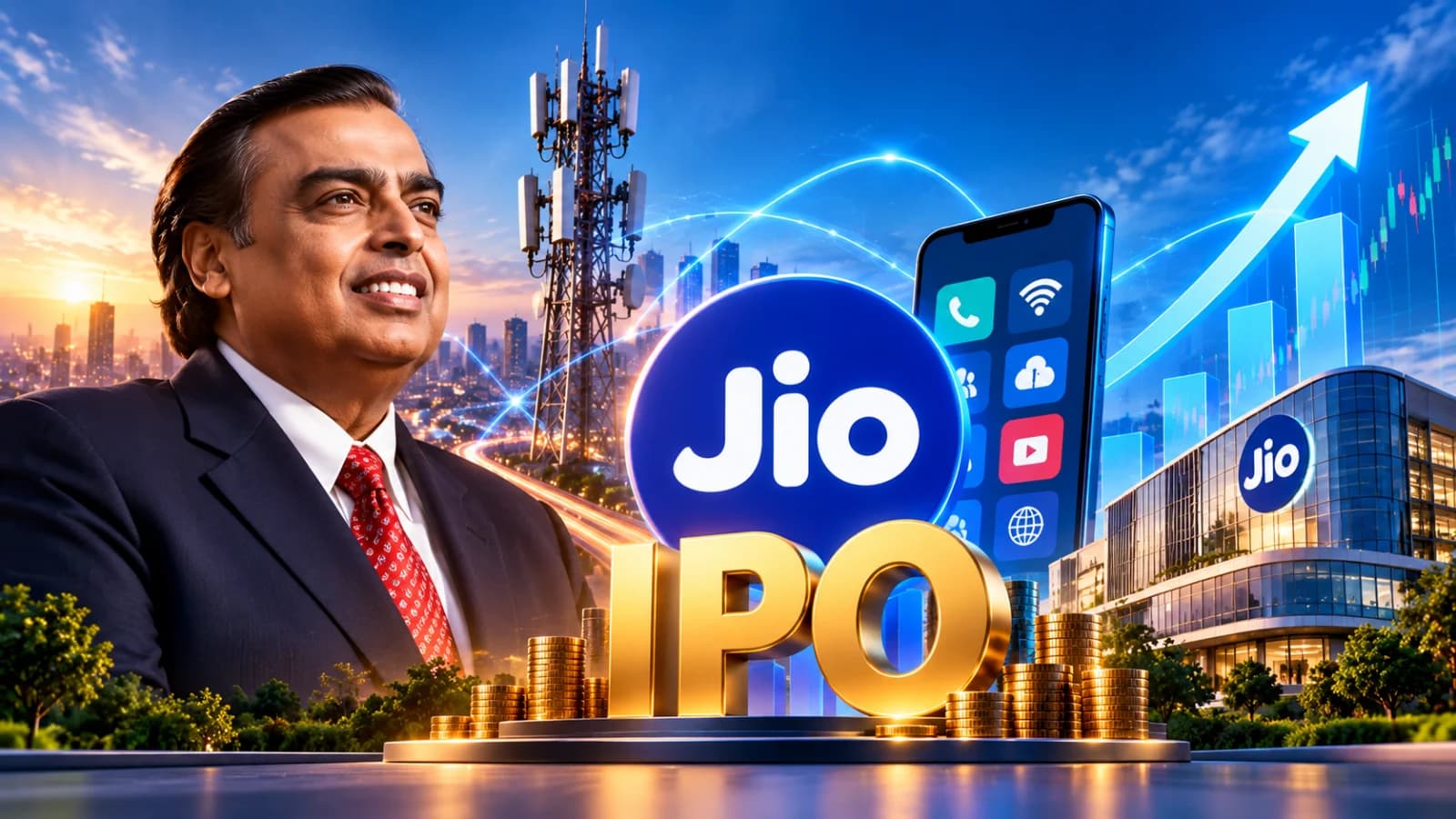
The Jio IPO is the first public share issue of Jio Platforms, the Reliance Industries company that owns Reliance Jio. Media reports say it opens on 21 October 2026 and could raise ₹37,000 to ₹38,000 crore, which would make it the biggest IPO in India's history.
It is a 100% fresh issue, most of the money will repay Jio's loans, and there will be a separate quota for Reliance Industries shareholders. In this guide I explain each of these in plain words, and I mark clearly what is confirmed and what is only reported.
One note first: the dates and the size come from media reports and the draft offer document. The final numbers will be in the Red Herring Prospectus (RHP), the final offer document, which is expected in mid-October.
Jio IPO at a glance
| Detail | What we know so far |
|---|---|
| Company | Jio Platforms Ltd, a subsidiary of Reliance Industries |
| Type of issue | 100% fresh issue, no offer for sale |
| Shares on offer | Up to 27 crore shares of face value ₹10 |
| Expected size | ₹37,000 to ₹38,000 crore (reported) |
| Anchor round | 19 October 2026 (reported) |
| Issue opens and closes | 21 to 23 October 2026 (reported) |
| Allotment | 26 October 2026 (reported) |
| Listing | 28 October 2026 on NSE and BSE (reported) |
| Price band and lot size | Not announced yet |
| Registrar | KFin Technologies |
Jio filed its draft red herring prospectus (DRHP), the first draft of the offer document, with SEBI on 19 June 2026, and SEBI gave its observations on 28 August 2026. Once the price band and dates are official, you can follow them, along with live subscription numbers, on IPO Verse.
What is Jio Platforms?
Jio Platforms is the holding company for Reliance Jio Infocomm, India's largest mobile network, along with Jio's home broadband, enterprise and digital businesses. At the end of March 2026, Jio had 524.4 million customers (about 52 crore), and each paid ₹214 a month on average, a figure telecom companies call ARPU (average revenue per user), as per Reliance's results for the March 2026 quarter.
Reliance Industries owns 66.43% of Jio Platforms. Most of the rest belongs to investors who came in during 2020, led by Meta (about 10%) and Google (about 7.7%), along with funds such as Saudi Arabia's PIF, KKR, Vista Equity, Silver Lake and Mubadala.
Here is how the business has grown, as per the restated figures in the DRHP:
| Year (to March) | Total income | Profit after tax | Total borrowings |
|---|---|---|---|
| FY24 | ₹1,10,175 crore | ₹21,434 crore | ₹54,349 crore |
| FY25 | ₹1,29,333 crore | ₹26,120 crore | ₹73,060 crore |
| FY26 | ₹1,49,759 crore | ₹30,053 crore | ₹70,781 crore |
Profit grew about 15% in FY26. Keep an eye on the borrowings column, because that is where most of the IPO money is going.
How big is the Jio IPO?
Reports put the Jio IPO at about ₹37,000 to ₹38,000 crore, roughly $3.8 billion. That is far bigger than the two previous record holders:
| IPO | Year | Size | Listing day |
|---|---|---|---|
| Jio Platforms | 2026 | About ₹37,000 to ₹38,000 crore (reported) | Expected 28 October |
| Hyundai Motor India | 2024 | ₹27,870 crore | Listed 1.3% below its issue price |
| LIC | 2022 | ₹20,557 crore | Listed 8.1% below its issue price |
What price does that size point to?
The company is offering up to 27 crore shares. Dividing the reported size by the number of shares gives a rough idea:
- ₹37,000 crore ÷ 27 crore shares = about ₹1,370 per share
- ₹38,000 crore ÷ 27 crore shares = about ₹1,407 per share
This is simple arithmetic on reported numbers, not the price band. By SEBI rules the price band has to be announced at least two working days before the issue opens.
Why is Jio offering only about 3% of the company?
According to Business Standard, Jio is likely to be valued at an enterprise value of $143 to 146 billion, above ₹12 lakh crore. Against that, a ₹37,000 crore issue is only about 3% of the company.
Earlier, the largest companies had to offer at least 5% of their shares at listing. On 13 March 2026, the government amended the rules so that a company worth more than ₹5 lakh crore can list with as little as 2.5% in public hands. It must then raise public shareholding to 15% within five years and 25% within ten years.
That second part matters if you are looking at Jio for the long run. It means more Jio shares are likely to reach the market over the next decade, either from Reliance and the other investors reducing their stakes or from new share issues.
Is the Jio IPO an offer for sale or a fresh issue?
The Jio IPO is a 100% fresh issue. There is no offer for sale.
- Fresh issue: the company creates new shares, and the money goes to the company.
- Offer for sale (OFS): existing shareholders give up some of their own shares, and the money goes to them, not to the company.
This is a big change from the last two record IPOs. Hyundai's IPO was entirely an offer for sale, so the money went to its Korean parent. In LIC's IPO, the government offloaded 3.5% of its stake. In the Jio IPO, Reliance, Meta, Google and the other investors are not cashing out. The company itself raises the money.
The other side of a fresh issue is dilution. New shares are created, so every existing shareholder's percentage falls slightly, including Reliance's 66.43%.
How will Jio use the IPO money?
The DRHP lists two uses:
- Repaying debt: up to ₹27,500 crore to prepay, fully or partly, foreign currency loans taken by Reliance Jio Infocomm.
- General corporate purposes: whatever is left. SEBI caps this part at 25% of the money raised.
At the end of FY26, Jio's borrowings stood at ₹70,781 crore. Repaying ₹27,500 crore would bring that down by about 39%. Less debt means less interest to pay, which can help profit in later years, though it does not guarantee it.
Reports say the remaining money could support 5G network expansion, home broadband, AI and cloud services. The RHP will give the final details.
Is there a shareholder quota in the Jio IPO?
Yes. The DRHP includes a separate category for eligible shareholders of Reliance Industries. Its size will be announced in the RHP. Under SEBI rules, a shareholder quota can be at most 10% of the issue.
Who is eligible for the Jio IPO shareholder quota?
- You must hold Reliance Industries (RIL) equity shares in your own demat account on the cut-off date. In past IPOs with such a quota, the cut-off has been the date of the RHP, so watch for it.
- One share is enough. Holding more RIL shares does not raise your limit in this category.
- Only RIL shares count. Shares of other group companies, such as Jio Financial Services, do not make you eligible.
- Mutual funds do not count. If you own Reliance through a mutual fund or index fund, the shares belong to the fund, not to you.
- Individuals and HUFs can apply. Holders of Reliance's global depositary receipts are usually left out.
Also remember that share trades settle one working day later (T+1). What counts is what is already in your demat account on the cut-off date.
If you are thinking of picking up RIL shares only to get into this quota, treat it as two separate decisions. RIL's share price can fall, and the quota only gives you an extra lottery ticket, not a sure allotment.
How does the shareholder quota help?
In IPOs with a shareholder quota, an eligible shareholder can usually apply in the shareholder category and also in the retail category, and the two bids are not treated as duplicate applications. Each category has its own allotment, so you get two chances instead of one. A bid in the shareholder category is expected to be capped at ₹2 lakh, the same as a retail bid.
Here is a simple example:
- Priya has 5 RIL shares in her demat account on the cut-off date. She applies for one lot in the retail category and one lot in the shareholder category. If both are oversubscribed, she gets two separate chances in the draw.
- Rahul, her brother, owns Reliance only through a Nifty 50 index fund. He cannot use the shareholder quota, but he can still apply in the retail category like anyone else.
Check the RHP for the exact cut-off date and bid limits before you apply.
How does retail allotment work in such a big IPO?
At least 35% of the net issue (the issue after reservations such as the shareholder quota) is kept for retail investors, who apply for up to ₹2 lakh. Not more than 50% goes to large institutions, called QIBs, such as mutual funds and insurers, and at least 15% to non-institutional investors (HNIs).
When the retail portion is oversubscribed, SEBI rules require that as many applicants as possible get one minimum lot, picked by lottery. So applying for many lots in the retail category does not improve your chances. One lot at the cut-off price is what matters.
The sheer size helps here. A rough example with assumed numbers: if the retail portion is about ₹13,000 crore and one lot costs about ₹14,000, there are about 93 lakh lots to go around. That is far more than in a typical IPO, though your real odds depend on how many people apply.
Jio IPO GMP and listing day: what can happen?
GMP (grey market premium) is the extra price at which IPO shares change hands unofficially before listing. Some IPO websites were already quoting a GMP of about ₹145 per share in the first week of October, before the price band was even announced. GMP is unofficial and unregulated, it changes quickly, and it has been wrong many times. Read what GMP really means before giving it any weight.
History is a useful reality check. The two previous biggest IPOs both listed below their issue price. Hyundai listed at ₹1,934 on NSE against its ₹1,960 issue price, and LIC listed at ₹872 against ₹949. Past listings are history, not a forecast for Jio.
These usually decide how a large IPO lists:
- Subscription, especially from QIBs: strong demand from institutions is the clearest signal.
- Price against value: once the price band is out, you can work out the P/E (price to earnings) ratio yourself, which is market value ÷ yearly profit. For example, if the IPO valued Jio at ₹12 lakh crore, the P/E on FY26 profit would be about 12,00,000 ÷ 30,053, or roughly 40 times. Compare that with listed telecom companies.
- Market mood that week: a falling market can drag down even a strong listing.
- Small float: only about 3% of shares will be in public hands, which can cause sharp moves in early trading, in either direction.
Long term or short term: how to think about the Jio IPO
RupeeVerse does not tell you whether to apply. What I can do is show you what each kind of investor should look at.
If you are thinking short term
- You are betting on the listing-day price, which depends on the factors above, not on how Jio's business does over the years.
- Gains booked within 12 months are short-term capital gains, taxed at 20%. Long-term gains above ₹1.25 lakh a year are taxed at 12.5%. Work out your tax with the capital gains calculator.
- Only use money you will not need soon. The amount stays blocked in your bank account during the issue and is released if you get no allotment.
If you are thinking long term
Read these in the RHP and in Jio's future results:
- ARPU and customer growth: whether each customer pays more over time and whether Jio keeps adding users.
- Debt after the IPO: whether borrowings fall as promised and stay under control.
- Spending needs: 5G, broadband and AI need heavy investment for years.
- Competition and regulation: Airtel and Vi, tariff decisions and spectrum costs.
- Dealings with Reliance: related-party transactions, meaning business done with the parent and group companies.
- Future supply of shares: Jio must take public shareholding to 15% within five years. Lock-ins matter too: shares held by investors from before the IPO are generally locked for six months after listing, and the promoter's minimum stake for 18 months.
What happens to Reliance shares after the Jio IPO?
- Reliance stays the majority owner. Its 66.43% will dip slightly because of the new shares.
- The IPO money goes to Jio Platforms, not to Reliance Industries.
- The IPO gives Jio a market price. Analysts who value Reliance by adding up its businesses, a method called sum-of-the-parts, can use that price instead of their own estimate.
Do not assume Reliance's share price will move in a fixed direction because of the IPO. It depends on many other things, from oil and retail to the overall market.
How to apply for the Jio IPO
- Keep a demat account with a broker and a UPI ID linked to your bank account ready.
- When the issue opens, find Jio Platforms in your broker app's IPO section, or apply through your bank's net banking (ASBA).
- Choose your category: retail, plus shareholder if you are eligible.
- Enter one lot, or more if you are applying in a non-retail category, and tick "cut-off price" so your bid is valid at whatever final price is fixed.
- Approve the UPI mandate on your phone before the deadline. Without it, your application does not count.
- Check your allotment on the registrar KFin Technologies' website after the allotment date.
Key takeaways
- The Jio IPO is expected to open on 21 October 2026 and could be India's biggest ever at about ₹37,000 to ₹38,000 crore. Dates and size become final only in the RHP.
- It is a 100% fresh issue of up to 27 crore shares. There is no offer for sale.
- Up to ₹27,500 crore will repay Reliance Jio Infocomm's loans, and the rest goes to general corporate purposes.
- Reliance Industries shareholders get a separate quota. You need RIL shares in your own demat account on the cut-off date, and one share is enough.
- GMP is unofficial, and the last two record IPOs listed below their issue price. Decide based on the business and your own goals, and speak to a SEBI-registered adviser if you are unsure.
Frequently asked questions
When will the Jio IPO open?
Media reports say the Jio IPO opens on 21 October 2026 and closes on 23 October, with listing on NSE and BSE expected on 28 October. These dates become official only when Jio Platforms files its Red Herring Prospectus, expected in mid-October.
Is the Jio IPO a fresh issue or an offer for sale?
It is a 100% fresh issue of up to 27 crore new shares, so the money goes to Jio Platforms. No existing shareholder, including Reliance, Meta or Google, is offloading shares in this IPO.
Who can apply in the Jio IPO shareholder quota?
Individuals and HUFs who hold Reliance Industries equity shares in their own demat account on the cut-off date, which in past IPOs has been the date of the RHP. Even one share is enough, but Reliance held through a mutual fund, or shares of other group companies, does not count.
What is the Jio IPO price band and lot size?
Neither has been announced yet. Under SEBI rules the price band must be announced at least two working days before the issue opens, and the lot size is announced along with it.
What is the Jio IPO GMP today?
GMP is an unofficial, unregulated number quoted in the grey market, and it changes every day. Quotes in early October appeared even before the price band was known, so treat them with care. Hyundai and LIC, the two previous biggest IPOs, both listed below their issue prices.
Sources
- Business Today: Jio Platforms IPO date, size, listing (5 October 2026)
- Business Standard: Jio IPO likely by October end at enterprise valuation above ₹12 trillion
- Business Standard: Jio Platforms receives SEBI observation letter
- Entrackr: Jio Platforms files DRHP for fresh issue only IPO
- Chittorgarh: Jio Platforms IPO details and DRHP financials
- Upstox: Does Jio Platforms IPO have a shareholder quota for Reliance Industries investors?
- Reliance Industries: Q4 FY2025-26 media release
- Kotak Neo: Centre eases minimum public shareholding norms (13 March 2026)
- Upstox: Hyundai Motor India lists at 1.3% discount on NSE
- Business Standard: LIC lists at 8.6% discount
This article is for learning only and is not investment advice. RupeeVerse is not a SEBI-registered investment adviser or research analyst. Please do your own research, or speak to a SEBI-registered adviser, before you invest.